
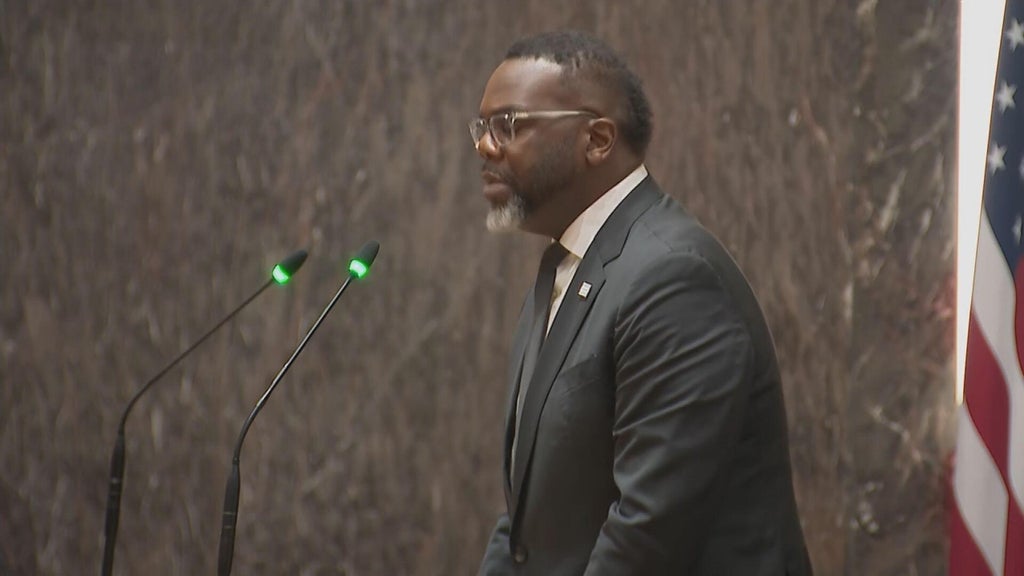
Chicago Mayor Brandon Johnson will unveil his $17.6 billion 2027 budget proposal for the city on Wednesday.
The mayor wants to take another crack at his controversial corporate head tax to help offset an $882 million shortfall, despite most aldermen warning him ahead of time such a proposal is dead on arrival. He is looking to charge companies with 125 or more full-time employees $25 per worker per month.
Companies whose employees work in parts of Chicago designated as Socioeconomically Disadvantaged Areas would qualify for credits to cover the cost of the tax for each employee in those areas.
While this tax is often called a head tax, Mayor Johnson prefers to think of it as the "equitable employer tax."
Mayor Johnson's office estimates the head tax would raise $101 million a year. He said it would affect less than 3% of Chicago's businesses.
The revenue would go toward pothole repairs, libraries, and gun violence reduction. Mayor Johnson made a comment about going to bat for young people in a video posted to his X account late Tuesday night, in the context of discussing teen takeovers.
"We have to create spaces for you all. It's why this budget is so critical, man! There are people fighting me on this budget, and they want me to lay people off, cut services, and not invest. And so you have a partner on the Fifth Floor. I'm always going to roll with y'all," the mayor told a group of young people in the video. "There are people who are blasting me, saying I'm making excuses for young people. I'm not going to let them treat you or call you out of your name, and I do need your help to make sure that our cousins are behaving responsibly."
Johnson proposed a $21-per-employee monthly head tax on companies with more than 100 employees as part of his 2026 budget proposal last year, and later revised it to a $33-per-employee monthly head tax on companies with more than 500 employees. The City Council voted it down, and the City Council Budget Accountability Coalition, which opposed the head tax, passed an alternate budget plan.
There is no indication that the parliamentary arithmetic in the City Council has shifted in favor of a head tax this year. Some Chicago aldermen warned weeks ago that a head tax proposal would be dead on arrival.
Last month, the 29 alders who are part of the City Council Budget Accountability Coalition sent a joint letter to the mayor declaring their willingness to work together on a budget plan. However, the group specifically requested no head tax, and said they would not support any move that increases costs for companies that keep or create jobs in Chicago.
The alders wrote to the mayor that while the current budget gap forecast is lower than previously estimated, "it remains a fiscal challenge of the first order," one which they believe three principles should anchor. One of those principles is rejecting a head tax or any other "tax on job growth."
The other two principles the alders are endorsing are rejecting an increase in property taxes and avoiding relying on "Springfield revenues that have not been approved."
Meanwhile, Johnson also will be proposing a 15-cent packaging waste tax that will be similar to the existing bag tax, bringing in an estimated $9 million. He also wants sports betting companies to pay a 20% tax, up from 10.25% to bring in $37 million, although the city's sports betting tax is facing a court challenge, with opponents arguing only the state of Illinois is authorized to impose such a tax.
The mayor also plans to increase personal property lease taxes from 15% to 20%. The tax rate for car leases would remain at 15%, while leases for film production equipment would see their tax reduced to 11%. The mayor's office estimates the changes to the personal property lease tax would generate $234 million.
Johnson also estimates the city will bring in an additional $18 million in parking ticket revenue from the plan to expand the Smart Streets program citywide. The program uses automated cameras to ticket drivers who block bus lanes, bike lanes, and crosswalks.
On top of the required $2.97 billion payment to cover the costs of city employee pensions, Johnson is proposing a $364 million supplemental pension payment.
The mayor also plans to declare a $520 million surplus in tax increment finance revenue. Of that, the city will net roughly $100 million, and $285 million will go to the Chicago Public Schools. The rest will go to various other government bodies in Chicago.
Johnson's team also suggests taking out a loan of $480 million to help pay off police misconduct claims sooner, which the team says would cut down on legal costs.
The mayor's acting budget director, Jonathan Ernst, said his office has been through every department line by line — shaving what it can without impacting city services.
The City Council has to pass a budget by the end of the year.
Mayor Johnson will deliver his budget address at 10 a.m. Wednesday.


