
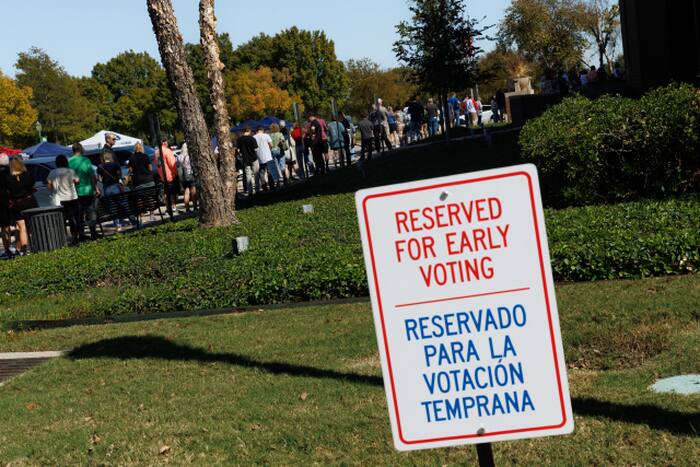
Nearly 4.5 million Texans cast a ballot in the first seven days of early voting — outpacing the turnout rate of the 2022 midterm election but slightly behind 2018, when Democrat Beto O’Rourke fell 2.6 points shy of toppling U.S. Sen. Ted Cruz.
From Oct. 19 through Sunday, 23.4% of registered Texas voters had cast a ballot or voted by mail, according to data from the Texas secretary of state. In 2018, the turnout was 24.3% in the first seven days of early voting.
Derek Ryan, a Republican consultant and data analyst, expects the pace of early voting to increase this week, leading to a busy day at the polls on Friday, when the early voting period closes. Election Day is Nov. 3.
“We could see anywhere between maybe 20 to 30% of the votes that get cast in this election get cast on Wednesday, Thursday and Friday this week,” he said.
Ryan predicts that as many as 10 million Texans may turn out to vote, which would put 2026’s final turnout in the neighborhood of 2018’s 53%.
Beyond the numbers showing enthusiasm for a non-presidential election year, experts warn against reading too much into early voting numbers. Texas voters do not register by political party, making it difficult to discern the partisan makeup of early voters. Consultants analyze past primary participation and use demographics to estimate trends.
Early voting data also offers an incomplete picture because each county self-reports daily results to the state.
“I think there’s sometimes a tendency to over-interpret early vote numbers because we don’t have good benchmarks,” said Mark Jones, a political science professor at Rice University. “It’s an evolving process, and every election tends to be a little unique.”
An analysis of the first seven days of early voting found those who had previously voted in a Democratic primary accounted for 35% of ballots cast, slightly ahead of 33% for Republican primary voters, Ryan said. About 29% had not previously voted or participated only in a general election, while 4% had mixed primary participation.
The early Democratic numbers were unprecedented, Ryan said.
“This is actually new territory,” he said. “I don’t think that I ever recall a point where voters with previous Democratic primary history have outnumbered voters with previous Republican primary history. … In 2022 and 2024 at this point, even in those earlier days, Republican primary voters were making up larger shares.”
Vinny Minchillo, a GOP strategist, said the initial Democratic surge shows their enthusiasm remains higher than the GOP’s, but it also has driven Republican turnout across the state.
“Their enthusiasm numbers and polls are not what the Democrats are, but that doesn’t mean they’re not going to show up,” Minchillo said. “After the first or second day of early voting, you’ve seen Republicans getting out. … So I have to say on behalf of Republicans everywhere, I am cautiously optimistic.”
Matt Angle, a Democratic strategist, said strong turnout in urban counties, coupled with rural voters accounting for less than 25% of all votes cast, was good news for Democrats.
“If you’re looking at turnout based on where it’s coming from, voter history and the racial makeup, then Democrats are doing better. They’re ahead of the pace that was in 2022 for sure,” Angle said. “There’s every reason to be optimistic but also it’s important to be realistic — we don’t know how people are voting.”
Harris County, the state’s most populous county, set a record for turnout for the first day of early voting in a midterm when more than 127,000 voted. Dallas County set a record for the most early votes on day one of any election when more than 88,000 people cast a ballot.
Angle said Democrats want around 40% of the final vote to come from large urban counties and less than 25% to come from rural counties — and the early vote shows those benchmarks being met. He’s also looking for stronger turnout among Latino communities.
“Hispanics have figured out that Republicans target them and are openly hostile to Hispanics as a group,” Angle said. “I think they’re reacting accordingly.”
Data compiled by Ryan shows Hispanic voters comprised 18% of early voters as of Sunday — 1 percentage point more than 2024 and 2 points above 2022. Angle said Democrats want Latino voters to make up about 24% of the final vote.
Ryan said he’ll be looking to hear from the more than 2.1 million Texans who voted in one of the last four Republican primaries but have yet to vote in the general election.
“For Republicans to have any chance of victory, they’re going to need to see a significant number of that 2.1 million to show up to vote,” Ryan said. “We’ll start really knowing what the picture looks like by Thursday or Friday.”
A record 19 million Texans are registered to vote in the Nov. 3 election — 7.7% higher than the number of voters registered ahead of the November 2022 midterm.
Disclosure: Rice University has been a financial supporter of The Texas Tribune within the past five years. The Texas Tribune is a nonprofit, nonpartisan news organization that is funded in part by donations from members, foundations and corporate sponsors. Financial supporters play no role in our journalism. Find a complete list of them and more information about our financial and disclosure policies here.


